A Triple Blessing
Ramadan, Roots and Resilience

Dear reader,
I’m so excited to be back to my Sunday morning ritual, writing to you, sharing my thoughts, reflections, and everything in between. I’ve missed this more than anything!
Here’s my first post-Ramadan Substack, I hope you enjoy it. And, as always, thank you for taking the time to read!
Now, without further ado… enjoy!
:)
Ramadan, and What It Really Feels Like
This is the first Ramadan I am spending fully in Egypt in seven years.
I got used to experiencing it elsewhere, in foreign cities, far from the Middle East, surrounded by a small constellation of Arab friends. Some of them were part of my daily life, people I loved deeply beyond Ramadan; others would reappear only for this month, as if summoned by something larger than habit or convenience.
Because that’s the thing about Ramadan, something shifts.
People gather. Even those who don’t particularly like each other, even those who carry distance throughout the year, find themselves sitting at the same table. Habitual relationships are put on pause, and there is a kind of collective suspension of ego. Ramadan creates a temporary world where connection feels almost inevitable.
At its core, Ramadan is deeply personal. It is a holy month, yes, but beyond the rituals, beyond fasting and prayer, it is a return inward. You are encouraged to worship, to pray more, to make duaa, to ask, to thank, to confront both what you have and what you lack.
But more than anything, Ramadan is about the self.
I once wrote about the concept of the self in Sufism, the idea that the nafs evolves through different stages over a lifetime. That the human journey is not static, but layered. You move, slowly and imperfectly, from one state of self to another, until you reach what is known as Al Nafs al Mutma’inna, or the reassured self. A state of inner peace. Of contentment. Of quiet certainty.
And every year, Ramadan feels like a return to that pursuit.
A chance to realign. To strip away noise. To move, even if it’s slightly, closer to that state of being at peace with yourself.
As I was saying, this Ramadan, unlike the past seven years, I experienced it in a Muslim-majority country. In a place where the language spoken around me is the language of the Qur’an.
And that changes everything.
It makes me realize, almost viscerally, what it means to belong to this culture. What it means to understand, not just linguistically, but emotionally, the words that shape my faith. It reminds me that being Arab and being Muslim, is not just an identity, it is an inheritance.
And in today’s world, that inheritance feels heavier. More political. More exposed.
As a Syrian, this feeling intensifies.
There is something paradoxical about it: coming from a country that has endured so much pain, and yet feeling an overwhelming sense of gratitude for having been born into it. I want to be clear, this is my personal experience, my personal perspective. I am not speaking for all Syrians.
But today, I have never felt more proud of being Syrian. More grateful for being Muslim. And even more so, for being a Syrian Muslim woman.
To some, this might sound like a triple burden. A triple marginalization. And honestly it did feel like that for a while, I have to admit.
But to me, today, it feels like a triple blessing.
When Culture Is Taken, but Meaning Is Not
Yet, as I reflect on Ramadan from here, I cannot ignore how differently it is being perceived elsewhere.
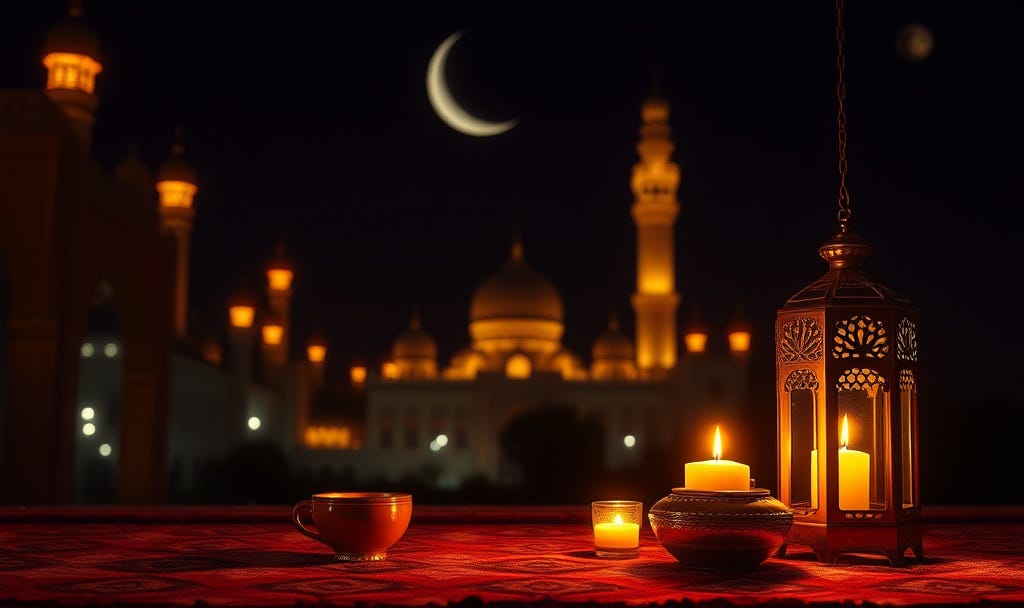
In recent years, Western media and global brands have increasingly embraced Ramadan, but in a way that feels… incomplete. They celebrate its aesthetics: the lanterns, the gatherings, the food, the warmth. Ramadan becomes a “vibe,” a visual identity, something marketable and palatable.
But its essence is often stripped away.
The spirituality, the discipline, the confrontation with the self, the very core of Ramadan, is rarely understood, let alone conveyed. What remains is a beautified, almost sanitized version of the month. A cultural artifact detached from its religious and philosophical roots.
It is a form of fetishization: wanting the culture, but not the meaning. I was confronted with this phenomenon a lot during my years at Sciences Po, French students who had just discovered the Middle East, traveled to Beirut, and came back speaking with a Lebanese accent. Believe it or not, it’s a real thing in France.
But this disconnect becomes even more jarring when placed against the broader political context in which Ramadan is unfolding today.
Because while Ramadan calls for introspection and peace, the world, particularly the Middle East, remains engulfed in violence. There is increasing talk of a “third world war,” with narratives about global alliances, collective responsibility, and the expectation that countries must align and contribute to military actions in the region.
But calling it a “world war” feels misleading. What we are witnessing is not a war of the world; it is a war imposed onto a region, a geopolitical struggle driven by specific actors with expectations that others will follow. And, as has so often been the case, the Middle East becomes the battlefield. It carries a historical weight, a shadow stretching across centuries, Dear Reader, play this audio while reading.beginning with the betrayal of the Ottoman Empire, cemented by the Sykes-Picot agreement, and extending to the present day. The artificial redrawing of borders disrupted long-standing social, political, and cultural balances, leaving a legacy of fractured states, contested identities, and recurring conflict.
Syria knows this reality intimately. For the past fourteen years, what was labeled a “civil war” has been less a domestic struggle than a stage for foreign powers to pursue their interests. Its evolution quickly outgrew the term “civil war,” becoming something far more complex, far more externalized.
This is not new. These are not hidden truths.
And yet, there is a strange amnesia in how the world speaks about current events, as if this pattern has not existed for decades.
Even in everyday moments, this realization surfaces. Listening to global news, hearing analysts cautiously reframe narratives, acknowledging, sometimes subtly, that this is not a collective war but a directed one. That the burden is disproportionately placed on the very region that is being destabilized.
And the price, once again, is paid by its people.
Faith, Fear, and the Politics of Perception
What makes this even more difficult is that all of this is happening during Ramadan.
A month meant for peace, unfolding in a context of violence.
At the same time, Muslim communities in Western countries are facing increasing hostility. Anti-Islam sentiment is rising, often fueled by political tensions and isolated incidents that are then generalized. Entire communities are made to feel suspect, their identities politicized and scrutinized.
Islam, in these narratives, is framed as something to fear. I personally know several families who have literally moved back to the Middle East because of the rise in islamophobia and racism against them, especially over the past year.
And yet, for muslims, & those who are exposed to Islam, Ramadan reveals the opposite: discipline, generosity, introspection, community.
There is a profound gap between lived experience and external perception.
Syria, Power, and the Illusion of Change
This brings me back to Syria.
Almost a year ago, I wrote that the future of Syria depends on its people, and that rebuilding the country must go beyond infrastructure. It must mean rebuilding citizenship, justice, and participation. And that women, in particular, must be central to that process.
Since then, Syria has entered a new phase.
When the previous regime fell, I, like many, felt something I hadn’t allowed myself to feel in a long time: hope. Despite initial skepticism, despite the deeply problematic backgrounds of emerging leaders, there was a moment where change seemed possible.
Perhaps, I thought, things could be different.
But hope is fragile.
Recent developments have raised questions that are difficult to ignore. Policies such as restrictions on alcohol, framed under religious or moral justifications, signal a shift toward a more conservative public order. And while I personally do not drink, the issue is not about personal practice, it is about inclusivity.
What does it mean to build a unified Syria if policies begin to exclude parts of its social fabric?
Syria has always been diverse, religiously, culturally, socially. Any vision of unity must account for that diversity, not suppress it.
At the same time, concerns about governance structures, such as the concentration of power within certain families, raise deeper questions about the nature of political systems themselves.
What is democracy, really?
Having studied political science, I have often questioned whether democracy, as it is idealized, has ever truly existed in a pure form. Even its earliest versions excluded large portions of the population (women and slaves). Today, its application varies widely, often shaped by context, history, and power dynamics.
There is no one-size-fits-all model.
But there are principles, participation, accountability, inclusion, that should guide any system claiming legitimacy.
And it is still unclear whether Syria is moving toward or away from them.
Women, Time, and the Work of Change
This uncertainty is especially visible when it comes to women.
Today, Syrian women are navigating a complex and fragile landscape. While some are beginning to engage in public and political life, their representation remains minimal. This is not surprising, 6 decades of authoritarian rule and deeply rooted patriarchal norms cannot be undone overnight.
Change takes time.
But time alone is not enough. It requires intention.
What is being done to actively include women? To create space for their voices? To ensure they are not once again sidelined in the reconstruction of their own country?
If rebuilding Syria is to mean anything, it must mean rethinking who gets to shape it.
Ramadan, Identity, and the Weight of Belonging
And this is where everything comes together.
Ramadan is not separate from these realities, it exists within them.
Just as the Palestinian cause, or Al Qadiya Al Filastiniya, continues to define and unite Arab identity across borders and generations, Ramadan also acts as a force of cohesion. It pulls people together, across differences, across geographies.
But unlike the way it is sometimes portrayed, it is not just about tradition or culture.
It is about meaning. About resistance, even.
Because today, to live Ramadan fully - to embrace its values, its discipline, its spirituality - is, in many ways, a political act. It is a refusal to let your identity be diluted, misrepresented, or stripped of its depth.
Spending Ramadan in an Arabic-speaking country, in this context, feels profoundly grounding. It reconnected me to something authentic, something unfiltered.
And it made me realize that identity, being Syrian, being Muslim, being a woman, is not something neutral.
It is something I carry, consciously or not, into every space I occupy.
Coming back to the Beginning
So, dear reader, I return to where I started.
Ramadan, and what it felt like this year.
It felt heavier, but also clearer.
I understood, more than ever, why I am, and should always be, proud to be a Syrian Muslim woman. Not despite everything, but because of it. Because this identity holds history, resilience, faith, contradiction, and hope, all at once.
And in a world that constantly tries to simplify, distort, or appropriate it, holding onto that complexity feels essential.
Ramadan, at its core, teaches you to return to yourself.
And maybe, this year, it has also taught me who I want to be and how I want to identify, to embrace my Syrianness fully and unapologetically, more than my Frenchness, because in these times, it matters more than ever, with a deeper awareness of what that truly means.
Beautifully written thank you for sharing,
A lot to go off in this writing but I would like to add my comment about a small part of it.
I think that in modern times ramadan has also become the victim of the algorithms on social media - just like christmas in most of the west being more about gifts and consumption than being thankful to christ nowadays. Ramazan in much of the muslim world is about the massive iftars, the post iftar shisha sessions and the date/peanut butter/chocolate hacks; not that i'm hating - they really are delicious.
This has been my experience with Ramazan for the past few years, spending time with family having dinners almost every night, meeting up with my best friends for post iftar shisha and tea every other day at our favorite 'ramazan spot' - which we ignore for the other 11 months out of the year.
This Ramazan however was very different for me. I absolutely love the added family time, connecting with cousins and aunts - chill nights chatting with friends - the laidback ramazan vibe I have adored for years before. However this year I really understood how personal of a month ramazan is, how its a month given to us for introspection - for really thinking about how we could nurture our soul and grow closer to god and receive his benefits. There's really so much to talk about Ramazan - especially in Turkey; a secular country in which the divide between religious(spiritual?) and non religious actions have been so politicized over the last few years, in a weird way this has made it sweeter and more satisfying to be able to see through and ignore all of this human made rift by turning my energy and focus inward this ramazan. I am so thankful for being able to spend my ramazan the way I did, and really hope that I will be able to continue to do so in years to come.
Just read through your and Ronaldo’s comments in addition to the beautiful post of course. Strangely, though I didn’t fast this year (or ever really, since I grew up culturally Catholic and fasting was just never a thing in our household) I also got more out of Ramazan than ever before this time around. As the main chef on hand in the household, I found that preparing meals for iftar, and looking forward to tea and talk afterwards, was something I cherished this year in ways that I’d been unable to access before. This could perhaps be because when the world (and in particular this region) is in such massive turmoil, a happy table and warm lights and food make you feel like you’re safe in a bubble, in ways that seem extreme when the reality outside is so different. As for the social media/meme representations of Ramazan and Muslim culture: these actually intrigue me, mostly because I’m so used to just seeing the Christmas/Christiany ones so that seeing hilarious memes about people missing their coffee/espresso machines during the month make it all super relatable in a “look at how universal human foibles are” type way. While I can also see how it makes it more superficial on some levels, I think those memes are doing the heavy lifting of removing (at least for Westerners) some of the disgusting Islamofobia perceptions that have been (purposefully I believe) planted in minds to make anything linked with Islam seem foreign, unrelatable, and completely (thus) undesirable.
As for the stuff about geography, words fail me as they do most of us at this point. Part of the strangest thing for me is witnessing the cognitive dissonance of life going on as normal for most people, while the outrage of what is happening is something we are surrounded by every day. Actually, let me be more specific: life of course goes on as normal (as it should while it can), but I find it strange that so many people find it unnecessary or even undesirable to EXPRESS the outrage of the things we see unfolding. This entire geography feels as though it is under the microscope of some bizarre science experiment which never should have been allowed to happen. America, sitting as it does across the ocean, feels of course no pain and no misery at the upending of so many lives and livelihoods. The disconnect is total. And this is so blatantly unfair on so many levels; maddening, horrifying, and wrong. It has been going on for so long though, one silver lining that I believe is happening right now is that people even oceans away are waking up to the imbalance, waking up to how wrong it all is. I fear the denouement that is coming with this current Iran “war”, but perhaps, like a volcano exploding, it will bring down some of the architects of this evil foreign policy.
I won’t comment on the Syrian political scene because I’m definitely no qualified. But what for what it’s worth, I saw from the beginning that the architects for the Project for the New American Century saw Syria as a potentially potent grounds for a globalist American proxy war with Russia. I also think Erdogan’s betrayal of Assad was one for the history books, for what its worth.
Sorry for the rambling reply!